By now you will have learned that the Army Corps of Engineers has stopped the pipeline construction. The piece that follows was written after I arrived back from my Thanksgiving trip there, a few days before the announcement. I’ve edited the story slightly, but by and large it remains the essentially the same as the one sent by email. This web-site version is my first attempt at the web for me. I’m hoping that it will reach those who said they didn’t receive the first.
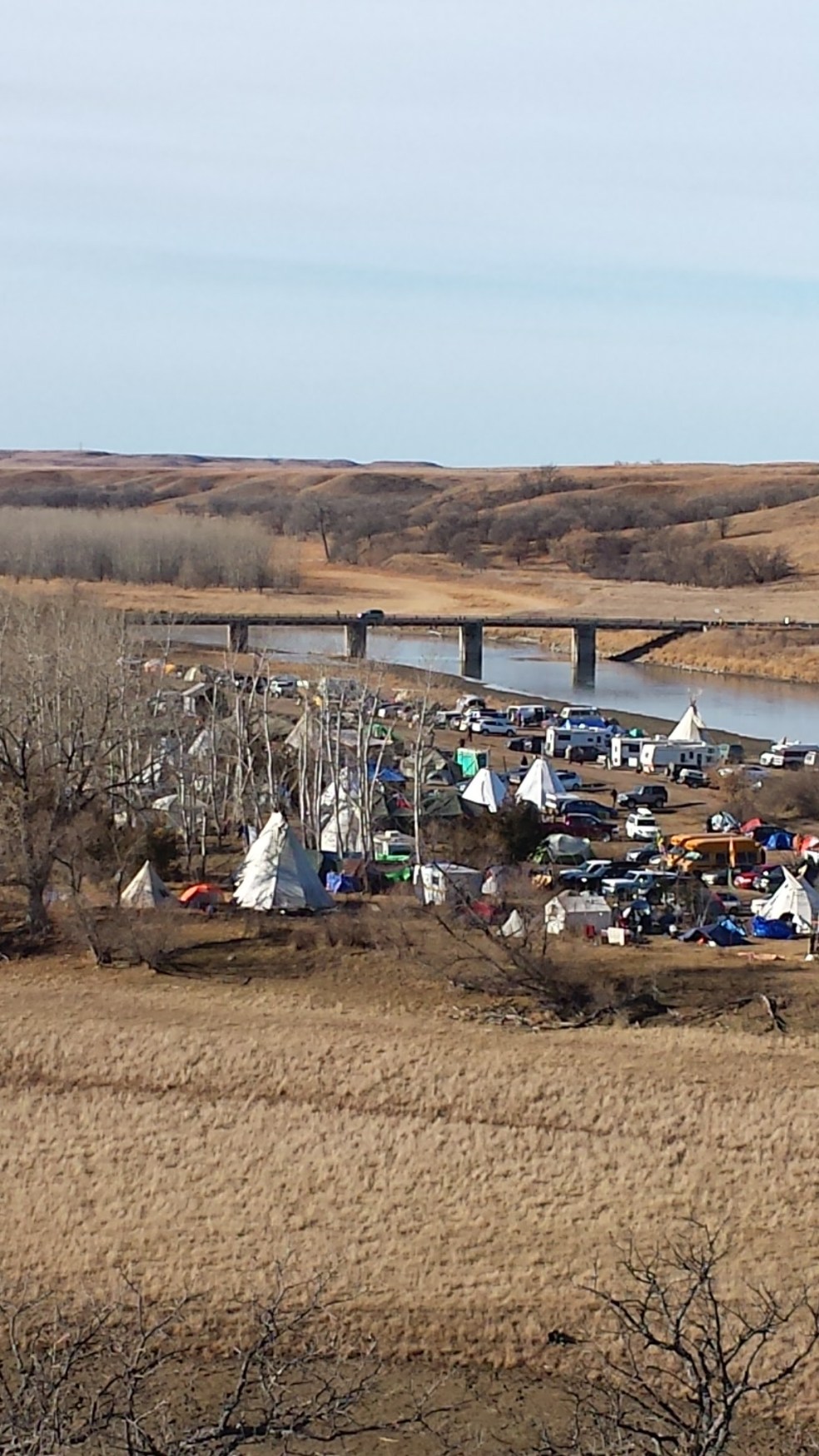
Standing Rock sits on the Cannon Ball River and consists of three camps. The Oceti Sakowin (pronounced och-et-ee shak-oh-win and means Seven Sacred Fires) is the largest by far and, and is across the river. Thousands are encamped there. Although part of the Sioux reservation, the Army Corps of Engineers has certain rights on that land and its occupation may be considered “illegal”. On this side of the river at the foot of the bridge to the left is Rose Bud, a smaller camp which also receives donations and houses (or should I say “tents”) – like the other camps – hundreds of native Americans from all over the county and the world. Just below the ridge and out of view is the third camp, Sacred Stone. This is also Sioux reservation land, but this portion is leased by a native women who heads the building of a settlement of school, a kitchen-dinning hall, a medical clinic, and other more permanent facilities. It is considered private, and law enforcement may not enter.
Of the three, we found Sacred Rock to be the most warmly receptive and well, sacred, spiritual. Open engaging talk and enthusiasm were everywhere evident. At the dish washing area, a couple of young people were washing dishes outside in large tubs with their hands deep in the water – mind you, North Dakota is cold – and the dad, standing nearby said as he watched, “That’s great you’re getting practice for when you get home.” They continued, beaming, obviously enjoying themselves.
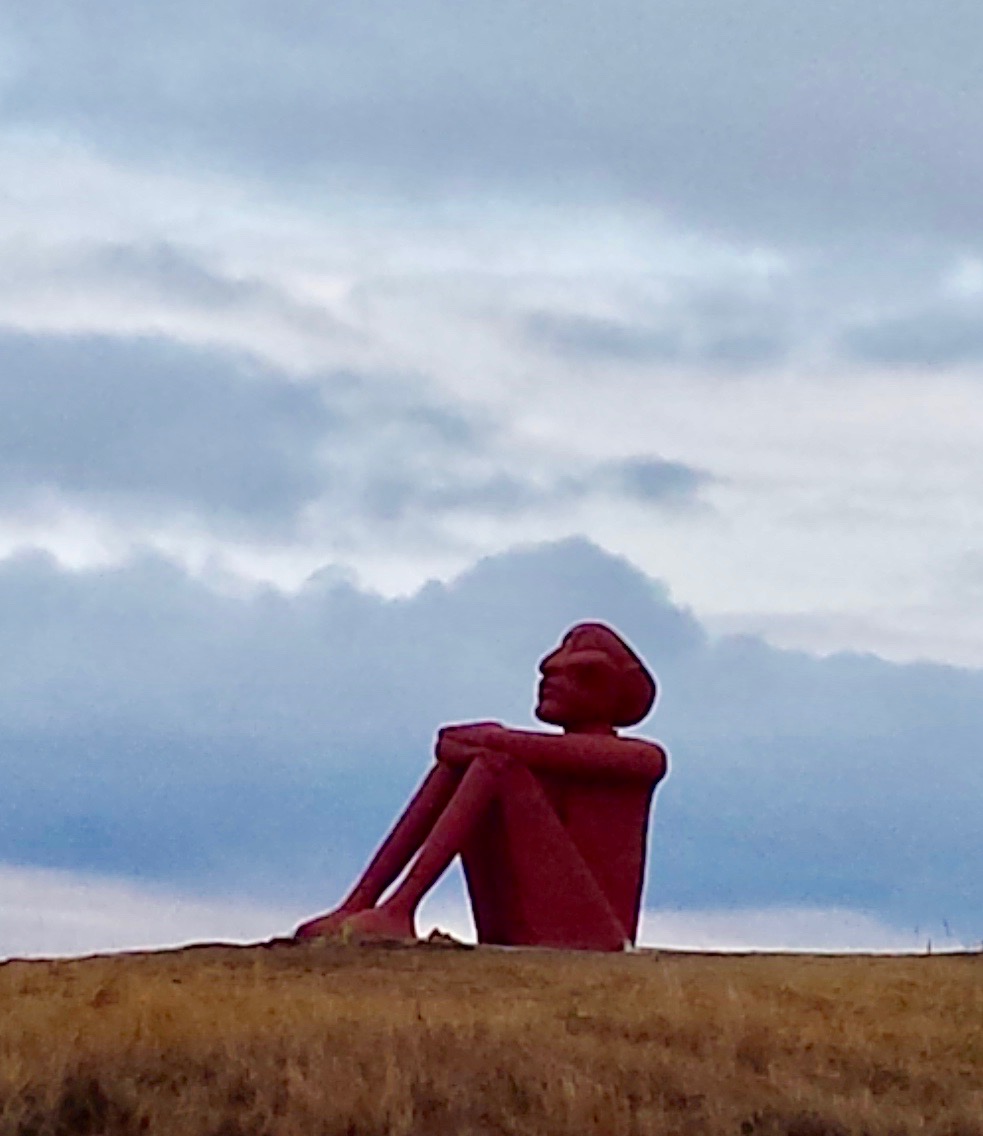

Sitting Bull of the Hunkpapa Sioux had a vision of victory, and along with other chiefs his leadership resulted in the annihilation of five of Custer’s 12 companies including Custer, and several relatives at the Battle of Little Bighorn. The metal sculpture of him – some 15-20 feet tall – sits atop a ridge at Scared Rock and gazes confidently over the proceedings below as the insistence of rights for his people continues. We are told that the gathering of Native Americans at Standing Rock is the largest since that battle in 1876.


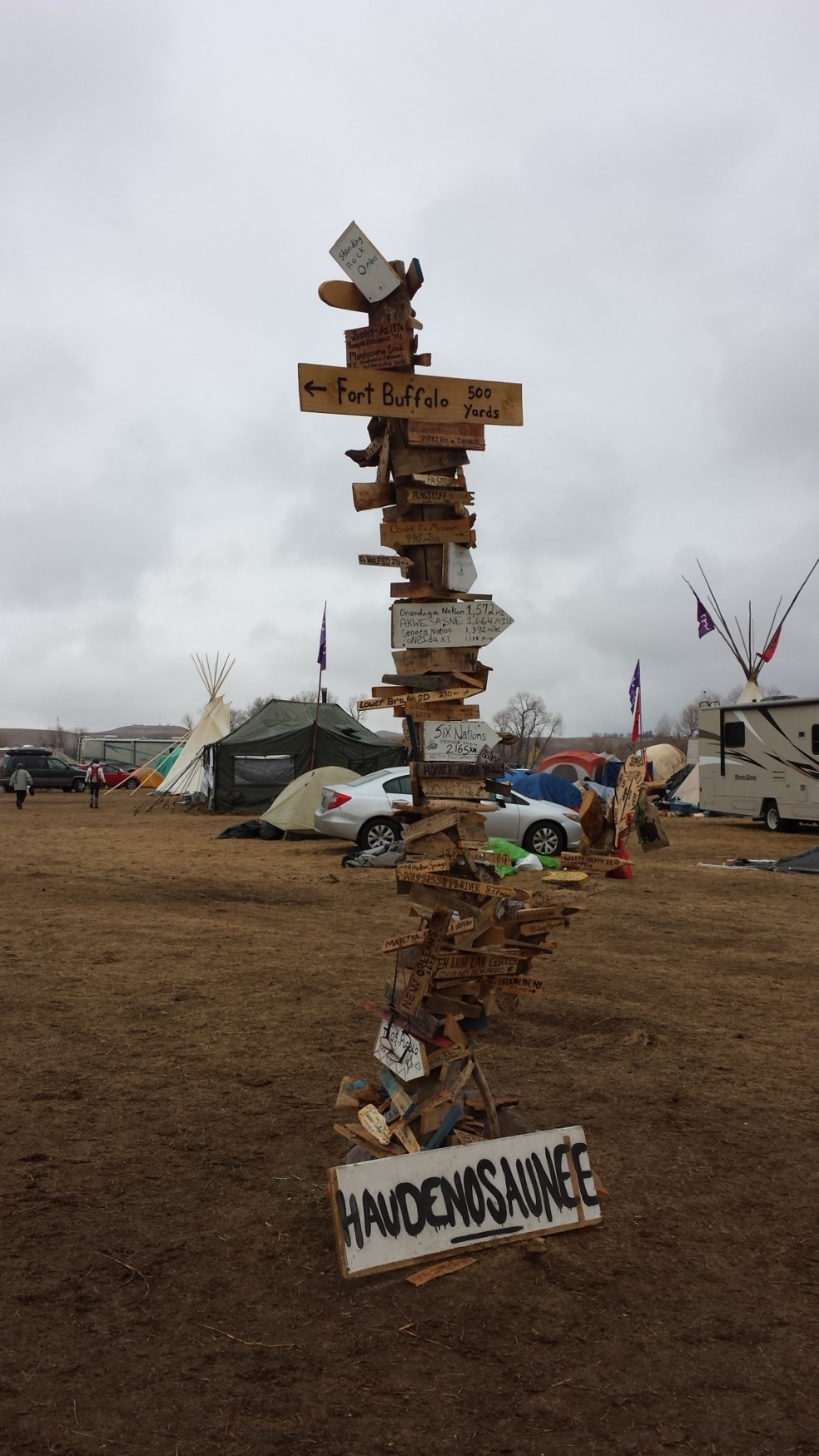

In the middle of Oceti Sakowin camp the many different tribes have placed directions to where their area of tepees, tents and shelters are. Except for more common names like Hopi, Taos, Pueblo, and Onandaga, these tribes and bands are mostly unfamiliar to me. Scrolling though and enlarging them might produce names you recognize.
The gathering of these clans has become an icon, and its name is Standing Rock. Yet it is a far larger movement. I felt I needed to go to support the Native American, yes, and also something else. At first it was not clear. As I spoke to individuals who gave me materials and funds, each person thanked me in much the same way. The gift was coming from a deeper place than simply support for a cause. Gradually I came to see that Standing Rock was drawing a line. So many years of killings, abuse, broken promises, gross injustices, robbing of freedom. That was it. No more. And that penetrated deeply into me.
No more. I too will not stand patiently by accepting all the inequality and injustices going on all around me. The wars, the violence, the criminal acts conducted by authorities, the greedy taking from the poor and powerless.
Without exception, those who gave me contributions to take to Standing Rock did so as if they were offerings for something sacred, from the heart. A young lady came up to me and gave me $16. She said, apologetically, that that was all she had. And she thanked me – like so many others who gave – with a deeply personal tone and quiet respect.
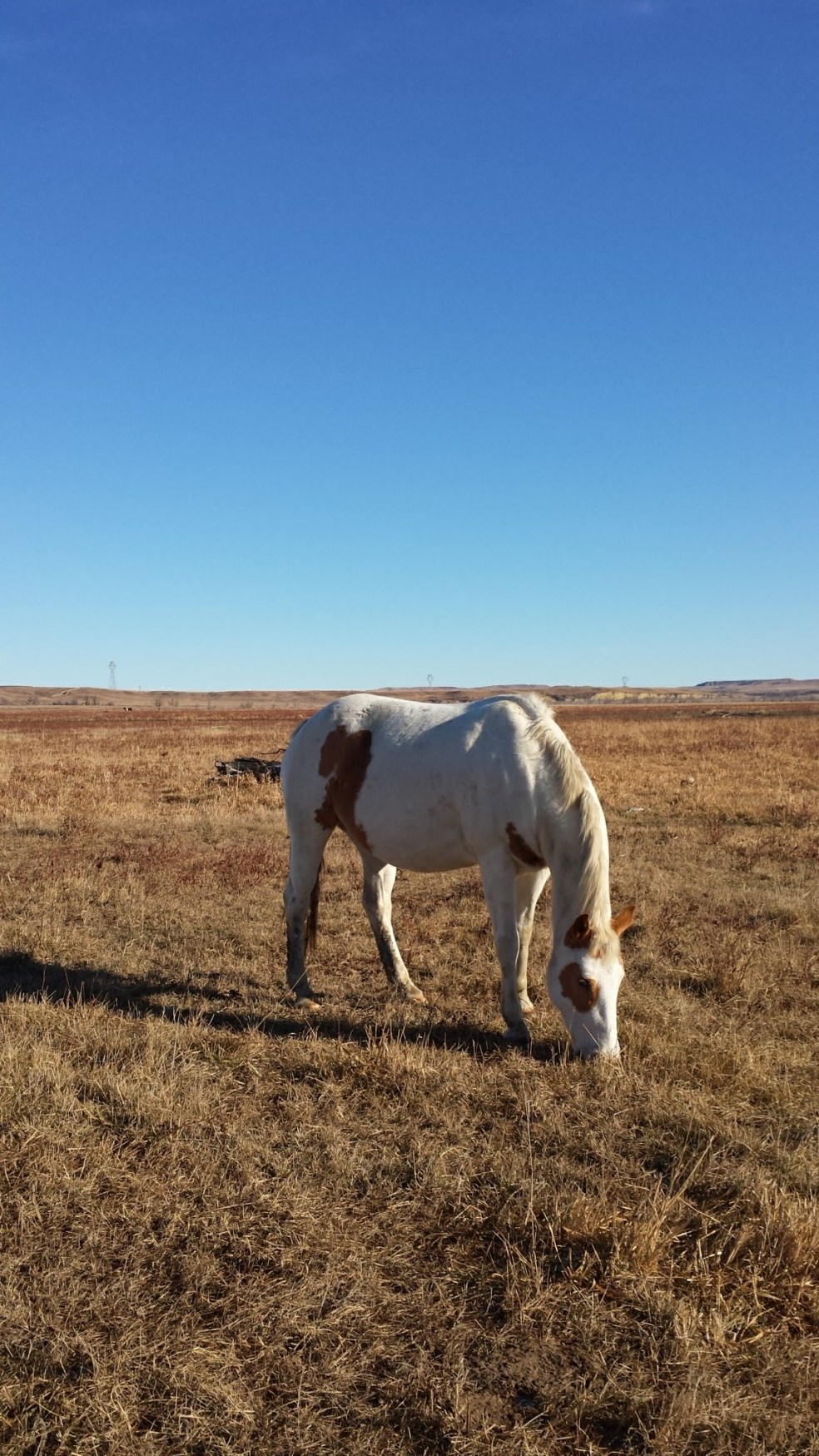
Horses are part of many tribal cultures, and these feeding freely south of the river were untied and content. The night before, as we were strolling back to our sleeping place a group of young Native Americans – all riding bareback – rode through camp calling out to those they passed in native dialect. They were answered in the same loud, crisp manner as when singing songs – not melodious, or for me at least, not charming or sweet. Rather, the boisterous sounds are exuberant, individual, wild. I was moved in hearing the exchanges, and felt glad.
Each camp has a sacred fire which is kept forever burning. An elder or two often sit quietly in folding chairs, bundled and unmoving. Near the fire are herbs, seeds, and aromatic leaves and branches that serve as offerings. I learned the procedure of praying at the fire through an elder who approached me when I had finished saying a prayer and turned around to go back to the bench where I had been sitting. He advised me softly to walk around the circle, and in that way, my prayers would be completed.

The evening before, I had been sitting in a folding chair at the sacred fire listening to songs sung in dialect. Several times I had taken out my handkerchief from the pocket in which I kept my car keys. The next morning, after looking everywhere and couldn’t find them, I went back to the sacred fire. My chair had been moved, and an elder was sitting in it. I mentioned the predicament, and he immediately got up to look under the cushion he’d been sitting on and behind his chair. I went to where the chair had been, and sure enough there they were lying in the dirt. I picked them up, approached the elder and shook them gently. The sound caught his attention, and when he saw them, a warm smile filled his face. I reached out to hug him, and he me.
In Sacred Stone, a new school is going up… quickly. The same school from a distance taken next day shows the new red roof already in place. Behind the structure, a warming house with a large propane heater serves to warm the workers, and in time the kids.
This is Rose Bud Camp, and beyond it the bridge the crosses toward Oceti Sakowin Camp, which was the first camp we went to. Rose Bud was the second, and after seeing how the third camp, Sacred Stone felt, we decided to give all our donations there. Monies I received were spent on propane fuel, individual camping burners to screw on the top of the gas canisters and a propane lantern in addition to a large canvas and a supply of tie downs for it.

The black sign shows: “Palestine and Standing Rock We are united” Taken from the hiway.
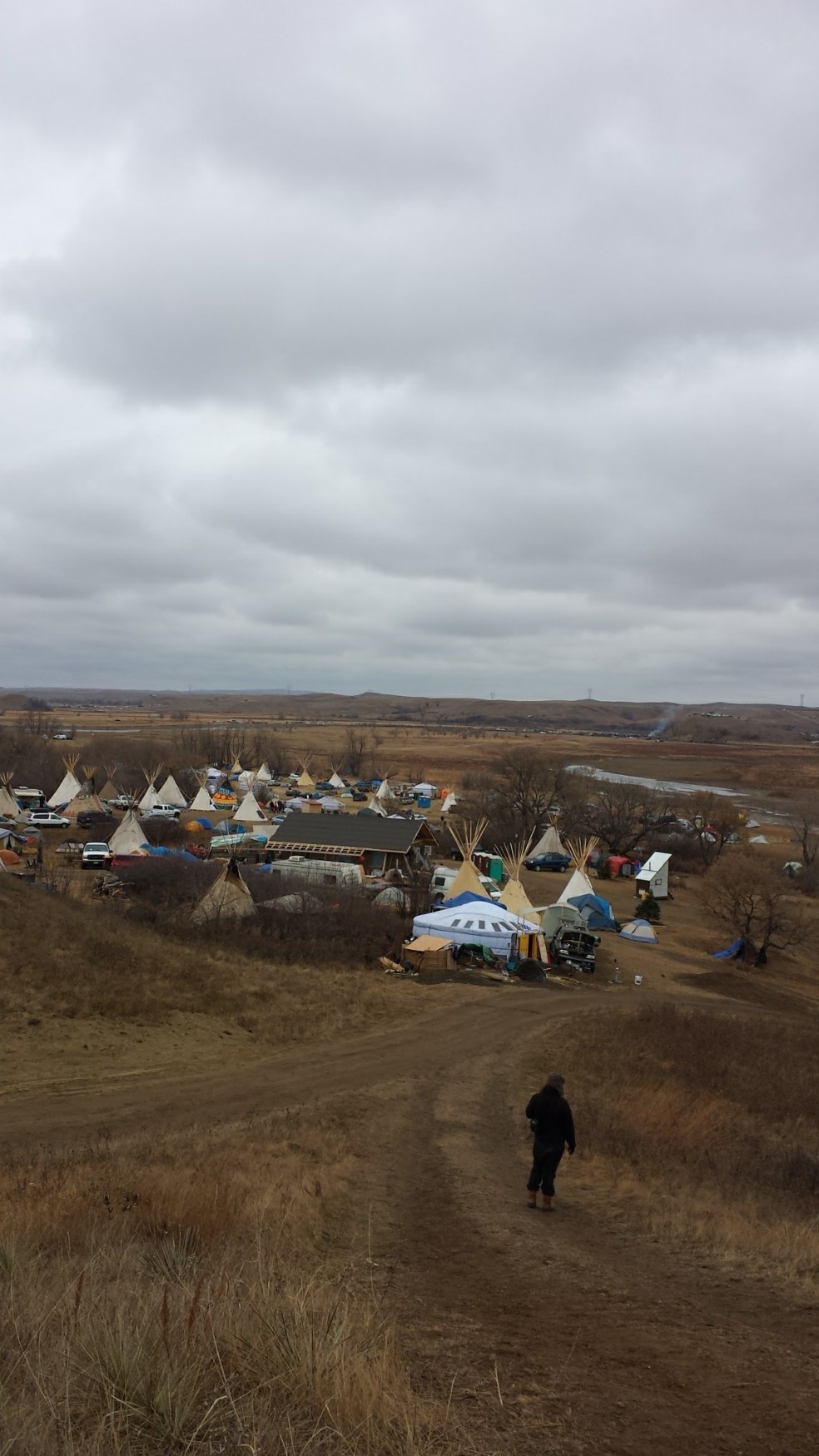
The settlement at Sacred Stone.
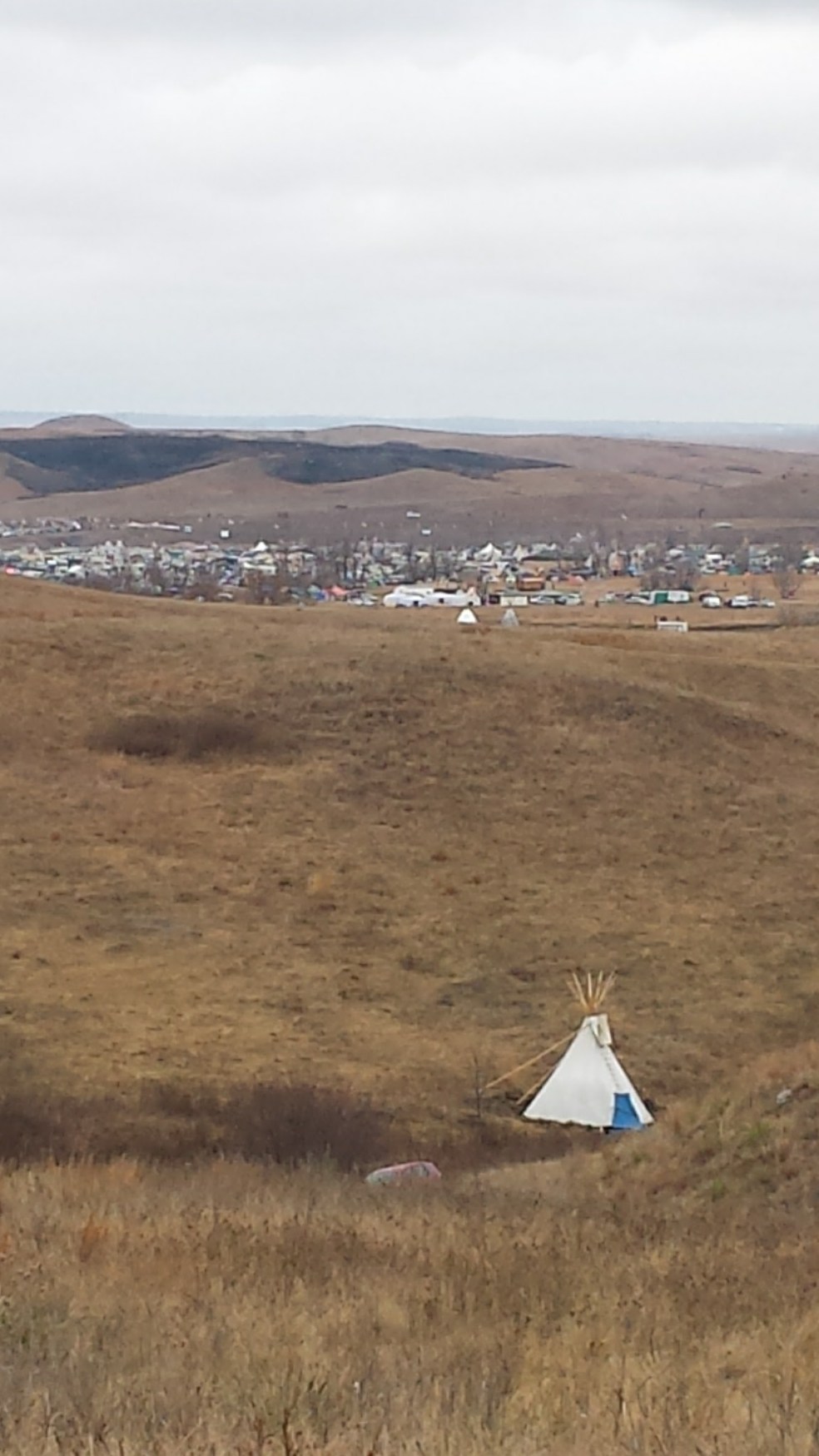
The lone tepee is a fitting conclusion to this story of strong individualists.






 Inner And Outer Travels